
An answer names a person, quotes a promise and adds a neat source link. It looks finished. But opening the link raises another question: does the exchange actually say what the answer claims?
A source can exist and still not support the sentence beside it. It can support one part of a sentence and not another. It can also be genuine and out of date.
For an everyday answer about your own history, the link is where checking starts. Open the source and see whether it backs the claim: who said it, what they committed to, when, and whether anything changed afterward.
Six ways a linked answer can go wrong
The six fictional examples below show how to read a source against the claim it is meant to support.
| Example answer | What the source actually contains | Check that catches the problem |
|---|---|---|
| “The meeting is Friday.” | A Tuesday message proposing Friday, followed by a move to Monday. | Read later messages and the final decision. |
| “Alex offered the introduction.” | Alex forwarded an offer written by Morgan. | Identify the original speaker, not only the sender. |
| “The price is $12 per month.” | A $12 monthly equivalent billed for a full year. | Inspect billing period and scope. |
| “Everyone approved the plan.” | Two participants replied positively; others did not reply. | Separate observed agreement from an inferred consensus. |
| “The request was rejected.” | A reply says it cannot be done this week. | Preserve the time condition and exact commitment. |
| “This person works at the company.” | A valid profile saved before a later job change. | Check the date and currentness required by the task. |
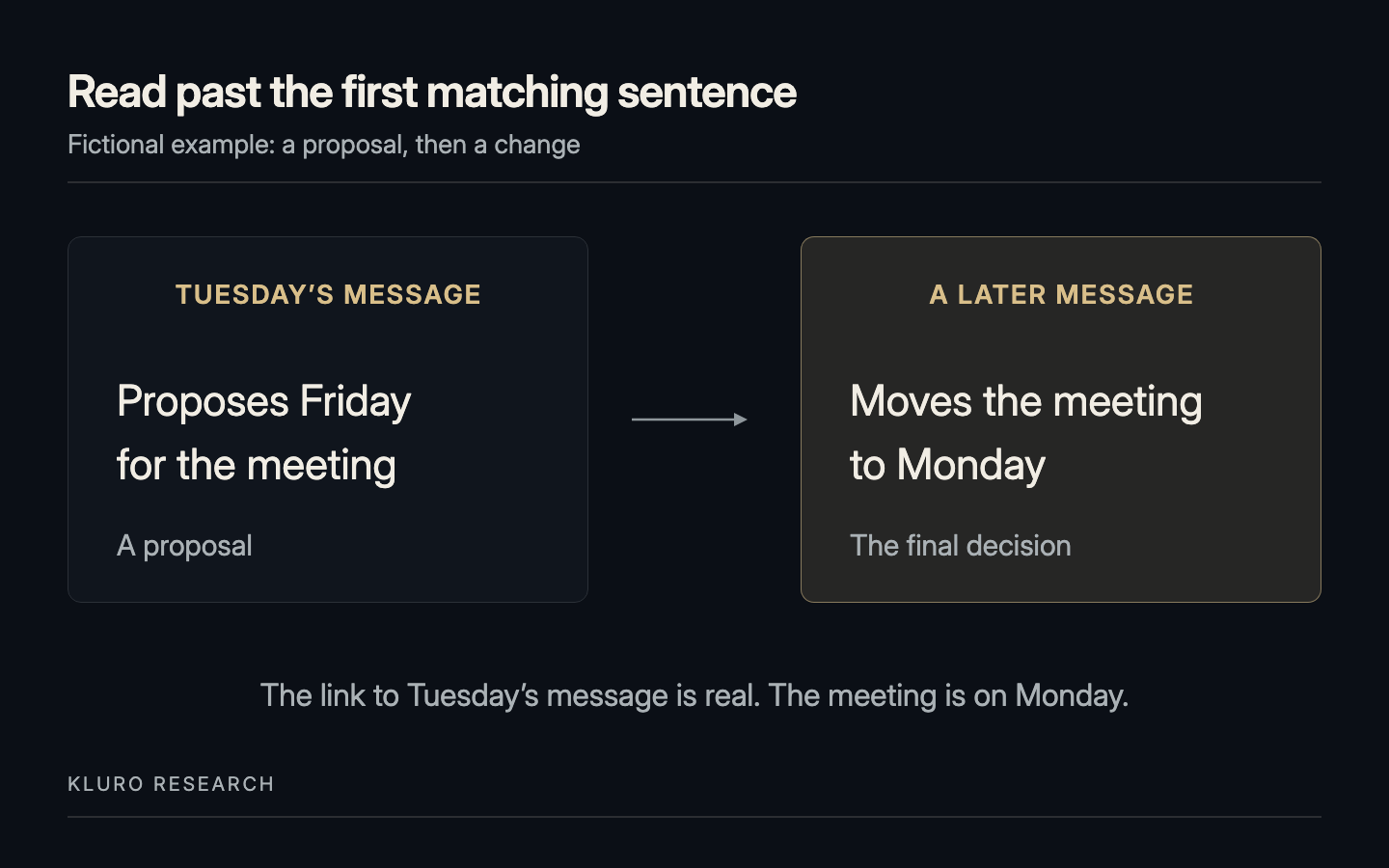
A valid link could appear beside every answer in that table. What went wrong is what the answer inferred or left out.
What published studies found
This distinction is familiar in published AI research. The 2023 ALCE work evaluated answer correctness and citation quality separately, instead of treating the presence of a citation as proof of accuracy. [1]
A Tow Center study published in March 2025 ran 1,600 news-excerpt identification queries across eight search tools and 20 publishers. More than 60% of answers were incorrect under that specific task, which tested attribution and retrieval from excerpts. [2] Both studies describe the systems and tasks tested at the time. Neither gives a failure rate for today’s assistants, or for every answer an AI system might give.
Check the claim in pieces
Break an answer that matters into its smallest claims. “Alex agreed to send the draft by Friday” contains a person, an action, a level of commitment and a deadline. One message might support three of those and leave the fourth unresolved.
This helps most when an answer combines several sources. A source about Alex’s role does not show that Alex made a particular promise. A calendar invitation does not show that everyone accepted it. When an answer joins two facts, the join is part of the claim and needs checking too.
Our citation-check worksheet has five fields: claim, source, exact supporting passage, date and unresolved inference. A casual search does not need that much; keep it for decisions that matter.
Read around the highlighted sentence
The highlighted line may be the closest match to your question without being the final word. Read enough around it to tell whether it is a proposal, a question, a joke, a quotation or a confirmed arrangement.
If you are asking how things stand now, look forward as well. A later correction can matter more than an earlier confident statement. Ask for the most recent relevant exchange instead of assuming the first source shown is the latest.
Take the same care over who said what. Forwarded email, quoted replies and shared documents can put several people’s words in one message or file. “Who sent this?” and “Who originally said this?” may have different answers. If you cannot tell who someone is, leave that open instead of quietly treating two people as one.
Check dates before trusting fresh-looking prose
An answer generated this morning can rely on a source from years ago. The time on the answer tells you when it was written and nothing about the age of its evidence.
For prices and product capabilities, open the company’s own current documentation. For a personal promise, look at later messages. For a research claim, note the study period and who was studied. Each goes stale in a different way, so a single “updated today” label cannot cover all three.
The same goes for summaries of summaries. If a meeting note is the only source, it can support a statement about what that note records. It does not necessarily show what was said word for word on the call. Our meeting-notes review separates audio, transcripts and summaries for this reason.
A useful answer can leave a small question open
An answer that admits a gap gives you something to act on: “The source contains an offer, but I have not found an acceptance.” That tells you what to ask next. A polished sentence that upgrades the offer into an agreement makes the decision easier only by hiding the missing step.
In Kluro, open the message behind an answer to check the person, timing and surrounding conversation. It is a quick way to distinguish what the source says from the interpretation built on it. See Kluro’s relationship workflow.
Method and limits
The six cases are our own editorial test set. The two studies are historical evidence about citation evaluation and news-source retrieval. We have not rerun them on September 2026 models or compared live model providers.
Sources
- Enabling Large Language Models to Generate Text with Citations — Gao, Yen, Yu and Chen / ACL. 2023-12. Checked against the 28 September 2026 research cutoff.
- AI Search Has a Citation Problem — Tow Center / Columbia Journalism Review. 2025-03-06. Checked against the 28 September 2026 research cutoff.